Open roles now draw more than 300 applications each on average, according to data from the recruiting software company Ashby (HR Dive). An employee referral is one of the few ways to make sure yours gets a closer look. This guide covers what actually happens when someone refers you, what the research says a referral is worth, where its limits are, and how to ask for one.
What happens when an employee refers you
The details vary by company, but most referral programs follow the same four steps.
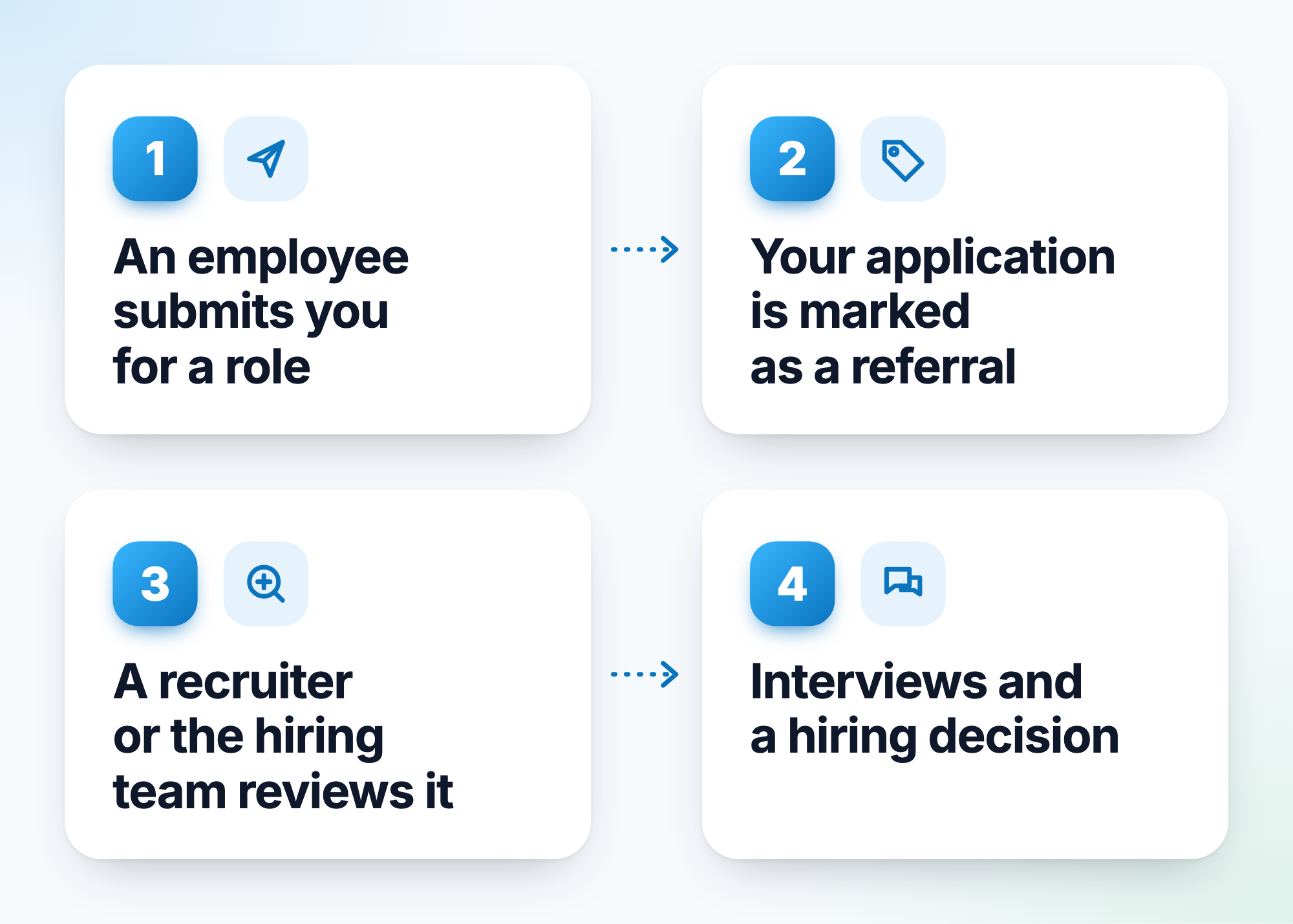
- An employee submits you for a specific role. They do this through the company's applicant tracking system or referral portal. GitLab's public hiring handbook, for example, asks referrers to explain "how you know the candidate and a comprehensive outline of why they are qualified for the role" (GitLab).
- Your application is marked as a referral. In Greenhouse, a widely used applicant tracking system, "the candidate's source must be Referral and you must be credited as the referrer" for the referral to count (Greenhouse).
- A recruiter or the hiring team reviews it. GitLab's handbook says referred candidates can expect a review from the hiring team within five business days (GitLab).
- Interviews and a hiring decision. From here, you go through the same process as everyone else. As Greenhouse puts it, "Hiring decisions are the responsibility of the position's hiring team" (Greenhouse).
Many employees refer people because their company pays a bonus when a referral is hired. That bonus usually depends on the new hire staying for a while. A 2019 SHRM article found that only 27 percent of employers pay the full reward as soon as the referral is hired (SHRM).
What the research says
One of the most detailed studies comes from economists at the Federal Reserve Bank of New York. They followed 62,127 applications to 315 positions at a single US company with 2,000 to 5,000 employees, from 2006 to 2010. Referred candidates made up 6.1% of applicants, but 21.4% of the people interviewed and 29.1% of the people hired (Brown, Setren and Topa).
62,127 applications to 315 positions, 2006 to 2010. Source: Brown, Setren and Topa, NY Fed Staff Report 568.
Compared with applicants from job boards, referred applicants in that study were more than twice as likely to be interviewed. Once interviewed, they were about 40% more likely to get an offer. The authors are careful not to make causal claims: referred candidates may differ from other applicants in ways the data can't see.
Other research points the same way. A study of nine large firms in call centers, trucking and high tech found that "referred applicants are more likely to be hired and more likely to accept offers, even though referrals and nonreferrals have similar skill characteristics" (Burks, Cowgill, Hoffman and Housman, Quarterly Journal of Economics). More recently, Gem's 2026 recruiting benchmarks, drawn from its customers' hiring data, report that "Referrals convert at 11x the rate of inbound applicants" (Gem).
What recent hiring data shows
Ashby, which makes applicant tracking software, analyzed more than 38 million applications for 93,000 jobs from 2021 to 2024 at companies on its platform (published May 2025). Referrals were only about 1% of applications. Yet 40% of referred candidates moved from application to interview, and 16% of the referred candidates who interviewed reached an offer. Offers for ordinary inbound applications fell from about 7 in 1,000 to 2 in 1,000.
What a referral doesn't do
Once you're in the process, a referral rarely changes how you're assessed. GitLab's handbook tells its team that "we treat Referral interviews the same as we do non-Referrals" (GitLab), and many companies work the same way.
Referrals also have a fairness problem. Employees tend to refer people with demographics similar to their own (IZA World of Labor), so candidates who don't already know someone at a company start behind. That gap is why ReferralHub exists: employees list the referrals they're willing to make, so you don't need an existing connection to ask.
When a referral helps less
- Very high-volume roles. Doubling a tiny chance still leaves a small one. With over a million applicants, a referral improves your place in the pile without taking you out of it.
- A weak fit. A referral gets your materials read. It doesn't change what's in them. Google's own advice is to make sure your resume clearly shows you meet the role's minimum qualifications.
- Jobs with higher education requirements. In the New York Fed study above, the referral boost to getting an interview was larger for postings that asked for a high school diploma than for those requiring a college or graduate degree.
- A referrer who doesn't know you. The value researchers find comes from information: an employee vouching for someone they chose to refer. A name passed along by someone who barely knows you carries less of that. The studies don't measure this case directly, so expect a smaller, less certain boost.
- Companies where a referral only tags your application. Sometimes a referral is just a record attached to your application. Microsoft's careers FAQ says a referral "does not replace the application process" and "simply helps connect you to the opportunity."
Do you still need to apply after a referral?
Usually, yes. Microsoft says you need to complete and submit your application to be considered, even after an employee refers you. The referral shows up in your candidate profile with the job, a link to its description and your referrer's name.
Cold applications still work, just at lower odds each: Ashby reports that inbound applications remain the dominant source of hires at the companies it studied. Do both when you can.
Does a Google referral help?
Google doesn't publish how it weighs referrals, so treat confident claims either way, including the ones on Reddit, as anecdotes. Here is what its hiring pages do say:
- You can apply for up to three jobs within a rolling 30-day window, and Google recommends narrowing down to roles that truly match your skills.
- Interviews are structured. Every candidate is assessed with clear rubrics, and the same rubrics are used for everyone being considered for a role.
- Most openings accept applications on a rolling basis until they're filled, so Google encourages applying sooner rather than later.
- Most Googlers applied for other roles at Google before they eventually made it to interviews.
Taken together with the research, the fair expectation is that a referral may help your application get read, and that your interviews will be the same as anyone else's.
Get the referral before you apply
How to ask for a referral
Whether you're messaging a former colleague or a referrer on ReferralHub, the same basics apply. UC Berkeley's career center suggests showing real interest in the company, briefly sharing your relevant skills and experience, politely asking whether they'd look at your resume, and asking about next steps, including "whether you should apply online first" (UC Berkeley Career Engagement). In practice, send:
- The exact job link or job ID. A referral is for a specific opening, so pick one or two roles you clearly fit.
- A resume tailored to that role, so the person reading it can see the match quickly.
- Two or three sentences on why you fit. This is what your referrer will paste into the note that goes with your application.
- Your LinkedIn profile and the email address you'll apply with, so the referral lands on the right application.
- A short thank-you. Berkeley suggests sending one within one to two days of the conversation.
Finding a referrer on ReferralHub
If you don't know anyone at the company, ReferralHub lists referrals that employees are offering. Every referrer verifies an email address at their company, and verifies it again each time they create or renew a listing. Each listing says which roles and locations the referrer covers. The referrer decides whether to take you on, since they're the one who starts the payment, and your referral should go in within 48 hours of paying (ReferralHub FAQ).
Start from a company page, such as Amazon, Salesforce, Adobe or NVIDIA, or see every company. Pick your role first, then choose a listing that covers it.
Sources
- Recruiters see job applications triple, to more than 300 per role (HR Dive)
- GitLab Handbook: Referral Program and Process
- Greenhouse Support: Referrals FAQ
- SHRM: 6 Tips for Effective Employee Referral Programs (2019)
- Brown, Setren and Topa, Do Informal Referrals Lead to Better Matches? (NY Fed Staff Report 568)
- Burks, Cowgill, Hoffman and Housman, The Value of Hiring through Employee Referrals (QJE, 2015)
- Gem: Key takeaways from the 2026 Recruiting Benchmarks Report
- Hoffman, The value of hiring through employee referrals in developed countries (IZA World of Labor, 2017)
- Amazon: FAQ, University Talent
- UC Berkeley Career Engagement: Asking for a Job Referral
- ReferralHub FAQ
- Ashby, "Are referred candidates more likely to get hired?" Talent Trends Report, May 2025
- Microsoft Careers, Hiring Process FAQs
- Google Careers, Our hiring process (including FAQs)